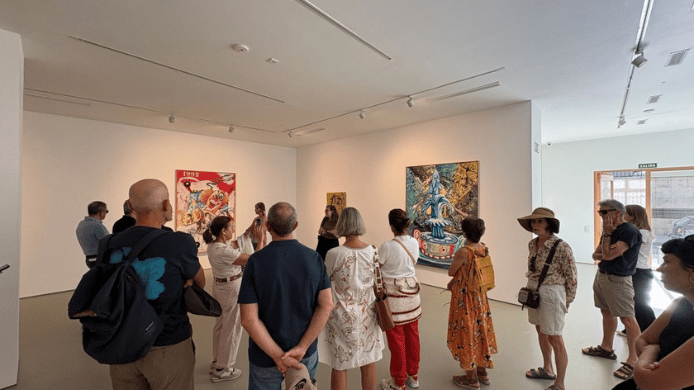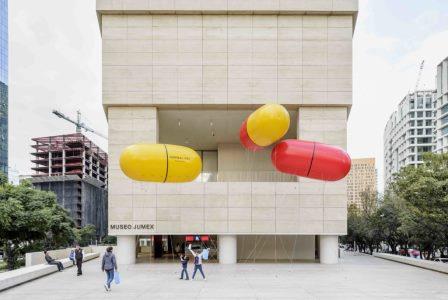
A set of screen-prints from the first Latin American retrospective of the legendary Canadian art collective General Idea, currently at Mexico City’s Museo Jumex, perfectly illustrates how a well-turned sign can tame real-life inequities. Titled “Fear Management,” it consists of eight sarcastic escutcheons that feature pizzle-shaped penises, cartoon skulls and lesion-like stains invoking the 1980s AIDS crisis.
Their lesson couldn’t be more timely: if you can picture it, name it, or, better yet, draw it funny on a placard, the act turns even the greatest injustices into a rallying cry.
Finding humor in the darkest situations was one of the hallmarks of General Idea, a pioneering group of Canadian conceptualists and media-based artists that transformed the viral inanities of late twentieth century popular culture into a playground for razor-sharp ironies. Formed in Toronto in 1969 by AA Bronson (born Michael Tims), Felix Partz (born Ronald Gabe) and Jorge Zontal (born Slobodan Saia-Levy), the group lived and worked together for 25 years, dividing their time between Toronto and New York.
The trio officially ceased joint art activities in 1994; that was the year Partz and Zontal died from AIDS-related illnesses, a scourge they worked hard to help destigmatize.
Inspired by late ‘60s psychedelia, free love, student revolts and the medium-is-the-message credo of Canadian theorist Marshall McLuhan, General Idea cribbed both its collective and individual identities from materials they had closest at hand—art and mass culture. Their use of personal monikers, for one, was lifted from pseudonyms widely employed by artists active in the conceptual global mail-art networks of the 1970s.
Similarly, the group’s artistic handle echoed the trade names of giant corporate entities, like General Mills and General Electric. Viewed sardonically, their faux-commercial alias fit the collective’s culture-baiting, piss-taking spirit like a snug “Bull Shirt” T.
Because General Idea’s artworks participated in rather than directly opposed mass culture, the trio became pioneers in the field of what we call “fake news” today. In 1972, for example, General Idea launched File Magazine, a publication that served as a global bridge for Toronto’s burgeoning arts scene (collaborators included the novelist William S. Burroughs, the art collective Art & Language, and the rock group the Talking Heads) while also mimicking the breathless celebrity twaddle of print media. The publication looked remarkably like Life Magazine—“file” is an anagram of “life”—so much so, in fact, that Life’s publisher threatened to sue.
As General Idea’s members explain in “Pilot,” a 1977 mockumentary-style video that introduces their survey at the Museo Jumex, the cease and desist letter they received accused the artists of “simulation of Life”—nothing more and nothing less.
Source: /news.artnet.com
Publicaciones relacionadas