By Hector Bosch
Photos: Abel Carmenate
People, who visit a sugar refinery, even if it isn’t active, can’t avoid imagining the intense movement around it. Those who have lived the height of sugar refineries on harvest time can’t forget it.
 That’s the case of Dagoberto Driggs Dumois, an artist that doesn’t aim his sight at an external reality, but he extracts it from the bottom of his memory, where it also becomes collective remembrance.
Exhibition Penultimas huellas (memorias de un batey) is an oneiric – and existential – journey through the memories treasured by Driggs on a family heritage of workers and members of that sort of small town built around the sugar refinery, which represents a characteristic of Cuban identity.
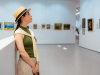
The artworks exhibited at Carmen Montilla gallery (Old Havana) move from utilitarian object to museum piece and artistic fact. Installative assemblies actually merge fragments or components of any machinery or constructive element in abeyance, with images created through a singular method of photographic printing on metal.
“This exhibition is a compendium of many years of work, not only to develop the printing technique, but the use of my experiences in a batey, in this case the old Santa Lucia sugar refinery, later called Rafael Freyre. There is an indispensable relation between the batey and the sugar refinery. If the first one doesn’t exist, the second one can’t exist either”, he melancholically expresses when he refers to the cessation of numerous sugar factories, which has substantially modified the sociocultural panorama of several Cuban territories. “In this first exhibition, I took into account the machinery that provided sustenance for the people in the batey”, he adds.
So, Driggs has put together those objects he believes represent a contribution to the rescue of identity, when they are no longer used. Afterwards, he turns them into two-dimensional or three-dimensional visual work. Some of these pieces can even gain a new use, a suggestion that, let’s just say, “closes” the author’s discourse like an endless cycle.
 Dagoberto Driggs jealously keeps the printing technique used on the images he tries to patent, those he has named with a suggestive wink: “dagorretype”. The method recalls the one used by the precursor of photography (daguerrotype). Nevertheless, the Cuban artist affirms he uses certain process to guarantee more perdurability and include some effects, relief for example.
The very assembly incorporates carpentry and tinwork, among other professions that contribute to the final result, in which we can recognize Driggs’ professional education as designer and his experience in terms of manual labor.
“I enrich the pictures with pieces I pick up and keep”, Driggs declares, and, with a sort of irony and affliction, points out: “I had loved to keep a locomotive, one of those that were used to build Panama Canal and are presently raw material. Can you imagine how much history they have? ”
“I also try to reuse elements of the batey’s architecture, such as the zinc of roofs, to obtain an idea of that place, and I give new functions to other pieces”, he explains, and refers to intrinsic matters of life in those towns: prostitution, parties, religious syncretism; all in all, aspects related to the identity.
Because the nearly-archeological work carried out by the artist goes beyond inanimate objects. With a sociocultural projection, he incorporates colors, sounds, scents and tastes to the creative process and the exhibition space: a replica of an old bell that calls for work, cane chunks, sugar grains, liquor and canchanchara, traditional drink based on its blend with honey and lemon.
 “I’m not only thinking on rescuing physical heritage, but also the intangible one. It can be done by talking to the people about things that existed. The title of my exhibition is Penultimas huellas because of the book written by National Literature Award Angel Augier, who was born in Santa Lucia and worked in a sugar refinery, and the titles of many of my works are taken from his poetries. And the point is that, nowadays, there are only penultimate traces of that sugar refinery. There will be nothing of it in the near future”, the artist asseverates with obvious affliction.
Since the effect of empathy is obtained through a singular and impeccable visual style, with one-of-a-kind pieces due to the complexity of their creation, and an evocative atmosphere, viewers can’t stay imperturbable when admiring this display of bittersweet melancholy.