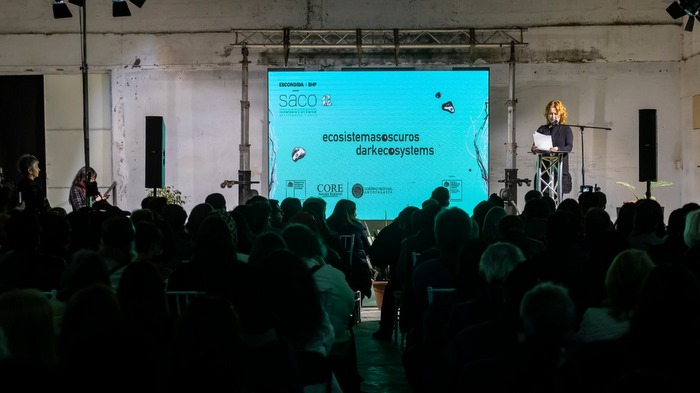
The twelfth edition of the SACO Biennial, titled Dark Ecosystems, officially opened in Antofagasta with strong attendance from artists, cultural leaders, and institutional representatives. The inauguration ceremony was held at La Molinera, where three rooms were also renamed in honor of key national cultural figures. The pedagogical dimension of this year’s edition was also highlighted.
One of the standout events already underway is Speculative Futures, an immersive exhibition by Argentine artist Joaquín Fargas. Opened on June 26 at Fundación Minera Escondida’s Art Gallery in Antofagasta, the installation features solar-powered robots in constant motion, creating a sensory experience where art, science, and philosophy converge to reflect on the relationship between technology and humanity.
Another highlight is Desert Connections, a public photography project featuring works by Osceola Refetoff (Canada–USA) and Alexandre Christiaens (Belgium, Wallonia-Brussels). Their desert-inspired pieces are displayed across three public billboard locations in Antofagasta as part of the SACO1.2 program.
Iranian artist Sarvenaz Mostofey, currently based in Berlin, presents Our voice is Echo!, an audiovisual installation focused on a collective of women musicians from southern Iran whose voices were silenced following the 1979 Islamic Revolution. Combining sound archives, interviews, and video, the work revives a story of resistance and empowerment, bridging past and present through a socially engaged artistic lens.
From June 30 to July 2, SACO1.2 will host its Regional Congress at La Molinera, transforming the space into a multidisciplinary forum that brings together national and international artists, scientists, government authorities, and local institutions to collectively address the challenges and potentials of northern Chile.
In this edition, the international presence expands with Overload (drawings of the earth), a site-specific project by Oslo-based artists Bianca Hisse, Shahrzad Malekian, and Christian Danielewitz. Their work explores the tensions between migration, mining, and ecology in the Atacama Desert through a collaborative performance and installation created with local artists. The project addresses both visible and invisible traces of extractive activity and engages the body, the landscape, and social memory.
On June 17 and 18, SACO1.2 also hosted an initial series of presentations at La Molinera featuring artists from around the world. Topics included technology, migration, memory, geology, and astronomy, fostering interdisciplinary dialogue among students, educators, and cultural actors.
Previous publication Fernando Marques Penteado presents "Tender, Trivial, Totemic Table Talks" at Nw, Aalst
Next publication Terraphilia: Beyond the Human in the Thyssen-Bornemisza Collections
Related Publications