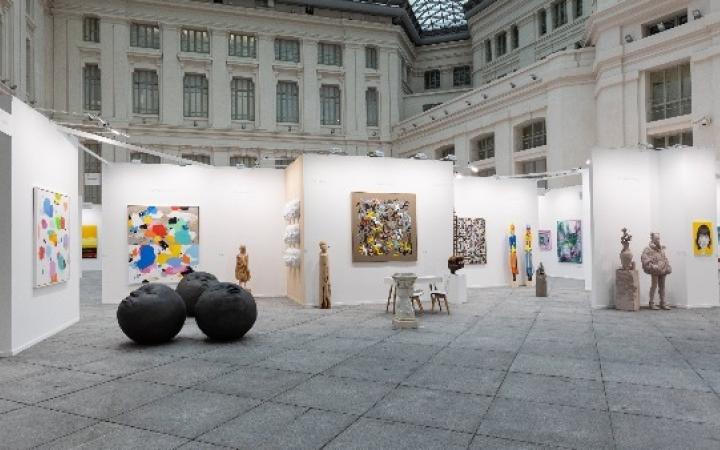
In 2026, Art Madrid will celebrate its 21st edition, further consolidating its position as a leading contemporary art fair in Spain. From 4 to 8 March, the fair will bring together thirty-five national and international galleries at the Galería de Cristal of the Palacio de Cibeles.
During the second half of the 19th century it began to take shape in the Dominican Republic. It was a national art form that though mainly expressed through pictorial art, counted on an essential expon
If there’s an esthetic expression that arouses amazement and suspicions virtually all around the planet, coupled with digressions, surprises and imitations –especially in the field of arts– that’s abst
When the gender theories are unknown, when no reading has been made, the joke seems to be the perfect way out. Feminism is more about lesbians with pent-up feelings, the interpretation of queer has to
The first thing that strikes the attention is the way it is marketed, dangling from strings that display dozens or hundreds of pamphlets. That’s where the name stems from: literature on string. Heiress
Since early 2010, Art by Excelencias has worked hard to beef up its stance worldwide and strengthen its distribution channels with foundations, art galleries, museums, academic centers and institu
“Exhibitions are stages of different insights and imply a true construction of senses”. With this statement, Maria Jose Herrera1 began the presentation of an important compilation (Exhibitions of Argen
The tragedy of a physical death will cause commotion; an allegoric death will make people shake far beyond the beauty it portrays
Since the year 2001, the Urban Culture Foundation (FCU) in Venezuela has been implementing an inter-generic multiple editorial program that includes the FCU’s main collection, the Cuadernos series spec
Borges who, as everyone knows, did not pride himself of being condescending, wrote a great praise about Alfonso Reyes; a few verses that could be either the preface or the conclusion of the book recent
Luis Camnitzer (1937) is not only critical of and wily about his artistic work, but also of and about his writing, an aspect he’s developed along the past 40 years and that speaks volumes –something th
Walls have always existed and apparently continue to exist: some have fallen definitively while others remain, and there are those that insist on raising new ones. In ancient times, they served to prot
The book entitled The Havana House: Typology of Housing Architecture in the Historic Center by Dr. Madeline Menendez, takes up a publishing slack about the studies –long on hold– in the field of Cuban
A large crowd of art lovers, the intelligentsia and news media from Madrid attended the February 18 grand opening of The One and the Many, Cuban Avant-garde and Contemporary Art.
The multidisciplinary exhibition Cuba. Art and History from 1868 to Date presented at the Pavillon Jean-Noël Desmarais at the Musée des beaux-arts in Montreal, Canada, from Jan. 31 through June 8, 2008