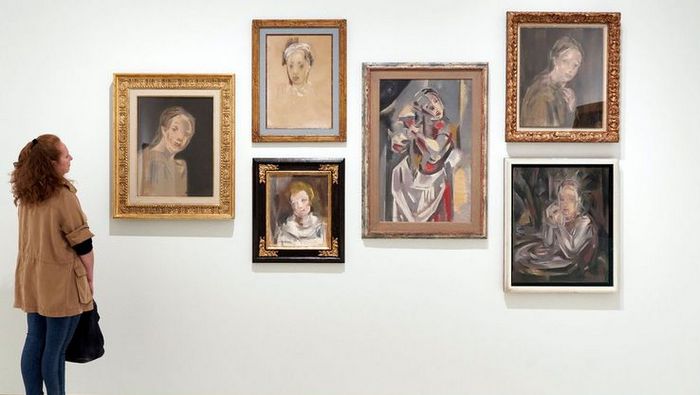
María Blanchard. A Painter in Spite of Cubism is a wide-ranging monographic exhibition that provides a chronological survey of the various stages in the career of the artist María Blanchard (1881–1932). It sets out to highlight the symbolic richness, social engagement, formal complexity and innovative nature of this painter’s work over the course of her relatively short artistic life. The powerful examples brought together here were undervalued in the cultural context of a period when women artists were presumed to be inferior. A cultured woman who remained faithful to her particular way of living and creating to the very end, she pushed the boundaries of the gender stereotypes of the day.
Blanchard was born into an educated, well-off family from Santander. At twenty-two, she began to study art in Madrid, in a conservative, academic environment typical of nineteenth-century Spain. During this formative period, she focused on pleasant, detailed portraits of the people dear to her, the genre themes that were so fashionable in turn-of-the-century Spain – such as the fictional construction of the sensual, wild image of the ‘gypsy woman’ – and romantic recreations of scenes from classical mythology.
In 1909, the Spanish artist made her first trip to Paris, the international capital of modernity, where she was brought face to face with the aesthetic radicality of the avant-garde movements taking shape in various European cities in the early twentieth century. There, she came into contact with the foremost practitioners of the new art, such as the Spaniards Pablo Picasso and Juan Gris, the Latin Americans Diego Rivera and Vicente Huidobro, and the Russian Marie Vassilieff.
María Blanchard took part in the first ‘Cubist’ exhibition in Madrid, organised in 1915 by Ramón Gómez de la Serna, receiving fiercely sexist criticism for her works. Disheartened by the bleakness of the Madrid art scene, where tradition and academicism prevailed, she left Spain for good. She returned to Paris that summer, seeking the atmosphere of renewal and experimental circles that had turned the city into an undeniable international hub of the new visual culture.
It was then that she fully joined the group of artists involved in the Cubist adventure. The movement had arisen from a small, improvised circle in the French capital a decade before it became a systematised theoretical discourse and was heralded and championed by so many painters that it eventually spread worldwide. This essential part of Blanchard’s artistic legacy, although short-lived, undoubtedly makes her one of the most important international actors of the Cubist movement.
Blanchard is notable for her contribution to the modern movement, and she was the first woman in Spain to systematically use the Cubist method to create images from fragmentation and the combination of geometric shapes in an optical space of simultaneous perspectives. Her period of strict, though versatile, adherence to Cubism ended around 1921. Girl at Her First Communion, which was painted in about 1914 in Madrid but shown at the Salon des Indépendants in Paris in 1921, can therefore be described as a programmatic piece, as it marked a turning point in her career. The 1920s witnessed a permanent shift to figurative painting, and her works recovered their noticeable literary quality.
Her third, post-Cubist stage was characterised by her deep concern with the human condition and emotions in the everyday world of women and children. During this period, she addressed gender, ethnicity, national identity and social class. The representation of these themes is reinforced by her meticulous technical mastery and scholarly interest in the history and tradition of Spanish, French and Flemish painting.
María Blanchard’s paintings are radical because they were a creative exercise in defying the hegemonic conventions of the modernity of her time. She was a woman in an art system dominated by a type of heroic masculinity that, for artists like her – a painter of female sadness par excellence who explored alternative modes of expression – meant renunciation, silence and exclusion. This exhibition seeks to draw attention now, in the twenty-first century, to the need to reclaim a prominent place in Art History for the work of María Blanchard.
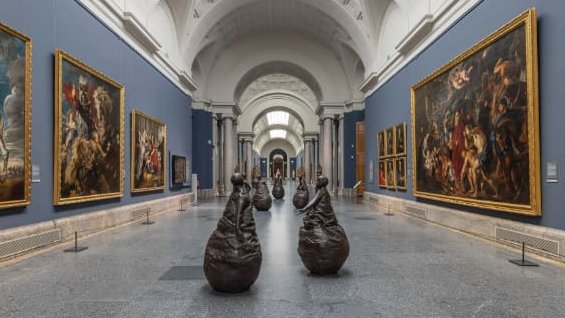
On the cover: A view of the exhibition. Photo: Jesús Domínguez. © Museo Picasso Málaga
Source: Museo Picasso Málaga
Previous publication GR gallery: 'Dimensional Fantasia'
Next publication else blankenhorn.! a retrospective the life of thought is real after all
Related Publications