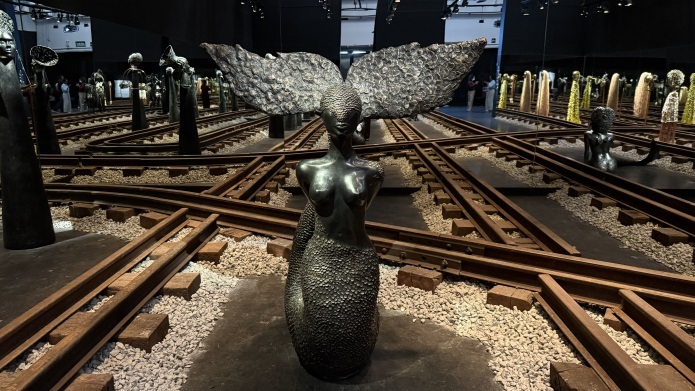
After being shown in Rio de Janeiro and Salvador, the exhibition “Ònà Irin: Iron Path” arrives in São Paulo at Sesc Belenzinho. This solo show by Nádia Taquary, curated by Amanda Bonan, Ayrson Heráclito, and Marcelo Campos, premiered at the Museum of Art of Rio (MAR) in 2023 and was later presented at the National Museum of Afro-Brazilian Culture (MUNCAB) until March 2024.
Originally trained in Literature, Taquary soon moved into art education. During a period of personal retreat, she encountered the book Círculo das Contas: Jóias de Crioulas Baianas, by researcher Solange de Sampaio Godoy, which sparked her interest in Afro-Brazilian jewelry. A visit to the Carlos Costa Pinto Museum in Salvador exposed her to the largest collection of pencas de balangandãs, enabling her to understand the history of a similar object passed down through her own family: a balangandã inherited from her great-grandmother, grandmother, and father.
These objects — sets of metal pendants attached to an arc — were worn by Black enslaved and freed women in eighteenth- and nineteenth-century Bahia, symbolizing faith, protection, and prosperity. Based on this research, Taquary created her first artwork, Abre Caminhos, a large balangandã featuring ten recurrent symbols found during her investigations. The work is included in the exhibition at Sesc Belenzinho.
In an interview with arte!brasileiros, the artist emphasized the importance of this jewelry for the women who used it as amulets. When a balangandã accumulated enough pendants and weight, it could even be exchanged to buy one’s own freedom or that of a relative. For Taquary, this narrative reveals a crucial Black protagonism that deepens and expands her artistic approach.
With no previous experience, she began sculpting Yabás, such as Oxum, Iemanjá, and Oyá. She explains that sculpture, as well as watercolor and painting, emerged intuitively, recognizing that artistic expression had not been encouraged in her upbringing, where becoming an artist was not considered a viable path.
The approximately 22 works presented at Sesc Belenzinho were created after the reflections that arose when she left Brazil. During that time, she experienced fear — fear of leaving her studio and of distancing herself from her language. In consultation with Ifá, the Yoruba oracle, Ogum appeared with the message that fear is a form of energy that must be transformed into strength. This insight gave rise to the title: “Where fear is, strength is also.”
In this context, she acquired small mirrors, created a paper base, and traced paths across the surfaces, allowing them to move forward and multiply in seven directions, referencing and saluting Exu. The resulting model eventually became the very architecture of the exhibition, as the curatorial team decided that the room should expand and receive the show within this structure.
In the exhibition space, the seven directions refer to Exu, while the train tracks evoke Ogum, the orixá associated with iron, technology, tools, and the opening of paths through dense forest or beyond cultivated land.
Recurring pieces in Taquary’s work include Woman Bird and Woman Fish, which also appeared at the 36th São Paulo Biennial. These sculptures derive from a Yoruba itan telling of a girl who menstruates for the first time, goes to the river to wash her clothes, and disappears for three days. On the fourth day, she is found atop a mountain holding a gourd with a bird inside. In the itans, the ancestral great mothers are said to have taken her to perform rituals and share knowledge about feminine power and the mystery of creation. The gourd symbolizes the creative mystery, and the bird refers to Oxalá.
With its arrival at Sesc Belenzinho, the exhibition is expected to reach a diverse audience. Curator Amanda Bonan notes that visitors often come to Sesc for various activities — swimming, lunch, leisure — and may encounter the exhibition unexpectedly, which she considers particularly meaningful.
The exhibition remains open to the public until February 22, 2026.
On the cover: Exhibition “Ònà Irin: railway path”, by Nádia Taquary, at Sesc Belenzinho. Photo: Luiza Lorenzetti
Publicación anterior PRINTMAKING TAKES OVER BILBAO
Publicación siguiente “Walter Benjamin Is Dead”: Dora García’s First Solo Exhibition at Elba Benítez
Publicaciones relacionadas